New Hezbollah museum puts spotlight on Syria intervention
In-depth: The newly opened museum in Baalbek showcases Hezbollah’s military intervention in Syria. Analysts say it is part of a strategy to define the group’s role in the region and influence its domestic image among supporters.
28 September 2023
Baalbek, Lebanon — Tourists arrive in hordes each year to Lebanon’s city of Baalbek, eager to see its ancient Roman temples.
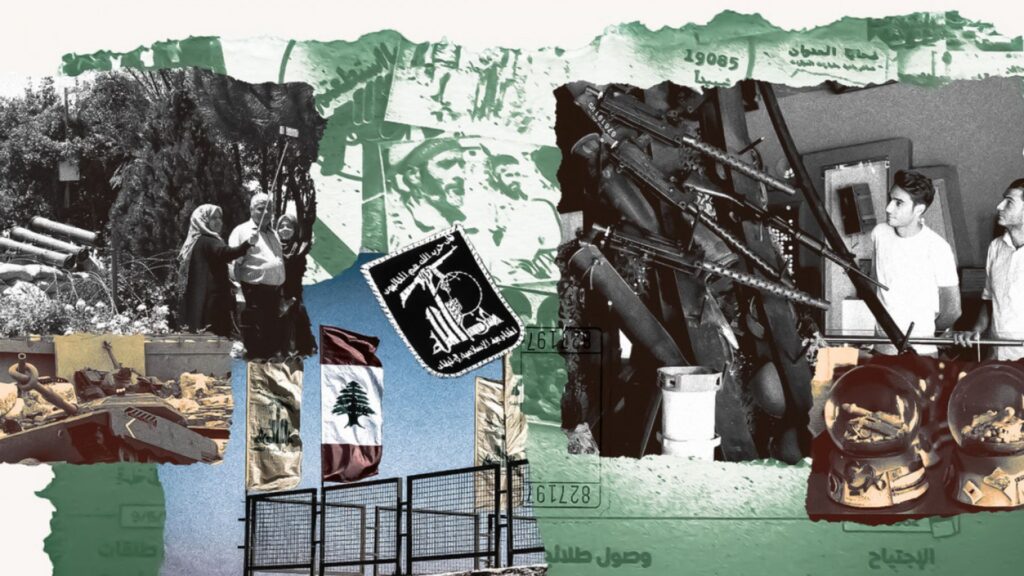
But today, another attraction is drawing in hundreds more – an extensive display of Hezbollah tanks, drones, and rockets, part of the militant group’s newly-opened ‘Jihad’ Museum.
As the road to the museum winds up from the well-known Temple of Bacchus, the yellow and green flag of Hezbollah crops up at every turn. Eventually, the road reaches the hill’s summit and the museum comes into view, marking the same place where the group carried out its first military exercises in 1982.
Visitors can then proceed down a canon-lined promenade to an arsenal of nearly 100 weapons, a collection the group acquired during Israel’s occupation of Lebanon and through its military involvement in Syria, and some even manufactured in Lebanon.
With an estimated stockpile of 130,000 rockets and missiles, and some 20,000 active fighters and 20,000 reserves, the Iran-backed Shia group has risen to become the world’s most heavily armed non-state actor.
The weapons have elicited controversy among Hezbollah’s adversaries, the party the only faction allowed to keep them after the end of the country’s 1975-1990 civil war.
A recent gunfight between Christian inhabitants of Kahaleh and Hezbollah members in August after a truck carrying weapons for the group overturned in the village further added to calls for their disarmament.
The museum spans 10,452 square meters, symbolising the area of Lebanon (10,452 square kilometres). “Here is the dignity of Lebanon,” Jawad Fadel Tlais, one of the museum’s managers, said with his arms outstretched wide.
The Jihad Museum is Hezbollah’s second, highlighting the group’s “resistance” against Israel, but also showcasing Hezbollah’s military role in Syria.
“The museum is a curation of linkages between totally unlinked conflicts,” Mohanad Hage Ali, a senior fellow at the Carnegie Middle East Center, told The New Arab. The group declares the expulsion of Islamic State (IS) militants from Lebanon in 2017 as the “second liberation”, in addition to the “first liberation” of the country from the Israelis in 2000.
“Connecting the Syrian conflict with the one in the south [against Israel] helps the organisation later on as it seeks to justify interventions in other places,” Hage Ali stated.
Meanwhile, at the museum, local children from Baalbek come to see the weapons. They pretend to drive the tanks, practice shooting the rapid-fire machine guns, and take selfies with the nine Lebanon-made drones mounted in the air.
Tlais noted Hezbollah’s aim to break down the “boundaries of fear”. “The children can have fun with the weapons,” he said. “It’s like a playground for free.”
A young Palestinian who lives in Baalbek told TNA while playing with the weapons: “I feel that we’ve won [against Israel]”.