Snowball effects of Lebanon’s economic crisis fall hard on Syrian children
Syrian children are among the hardest hit as Lebanon’s public education system falters under the weight of economic crisis and dwindling funding.
23 October 2023
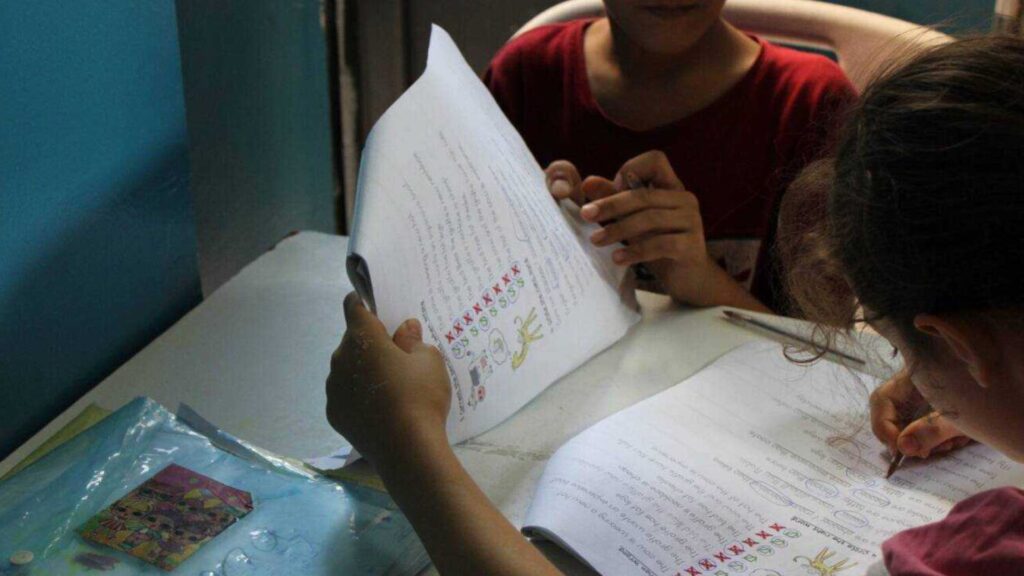
Beirut, Lebanon – At a learning center nestled in Beirut’s Hamra neighborhood, a cacophony of voices rang out one day in October. Inside, children pointed to giraffe, elephant and octopus cut-outs pasted on the walls, shouting animal names out loud in English. A few older children sat nearby with volunteer teachers, completing workbooks of English activities while others drilled math problems.
The center, 26 Letters, currently offers alternative education to 131 Syrian refugee students in Lebanon’s capital city. “It’s the place I felt safe and welcomed,” the center’s youth director, 19-year-old Issa Mustafa, told Syria Direct. Issa began as a student at 26 Letters soon after he fled Syria in 2016.
Because Issa, like the vast majority of Syrians in Lebanon, does not have legal residency, he was not able to take the exam required to begin secondary school. 26 Letters, a small, volunteer-based nonprofit founded in 2015, was the only education option he had left, he said.
Hundreds of thousands of children and youth, like Issa, have fled from Syria to neighboring Lebanon since the war began more than a decade ago. Lebanon currently hosts the highest number of refugees per capita in the world, while also facing one of the world’s most severe economic crises, caused by financial mismanagement and corruption by its sectarian ruling elite.
Four years into the crisis, Lebanon’s state coffers are bone dry, leaving the public education system in tatters. The estimated 660,000 Syrian refugee children living in the country are among those hit hardest. When funding for schools and teachers runs low, services for Syrians are often the first to be cut.
This year in Lebanon, the start date for Syrian students—most of whom attend “second shift” afternoon classes in public schools—was pushed back to at least the end of October, UNICEF Chief of Education in Lebanon, Atif Rafique, told Syria Direct. Lebanese students began their classes on October 9, while registration for second-shift Syrian students is set to begin on October 30.
At 26 Letters—which is not an official school—more than 4,000 children are on the waiting list to take courses, the center’s founder, Janira Taibo, told Syria Direct. Most are Syrian, while the list also includes a number of Lebanese children and children of other nationalities.
Syrian children face huge obstacles to school enrollment in Lebanon. More than half of all Syrian children, ages three to 18, are not in school and many have never stepped foot in the classroom, Rafique said. And more than 99 percent of all non-Lebanese students, most of whom are Syrian, are not enrolled in secondary school past the ninth grade.
UNICEF only subsidizes public education in Lebanon until the ninth grade, the compulsory years. Afterwards, “you have a real cliff for the most marginalized,” Rafique said, with few non-Lebanese students continuing to higher grades.
“This is devastating for children and their life chances,” the UNICEF education chief added.