‘We will never forget’: Reliving the pain of the Nakba amid Israel’s war
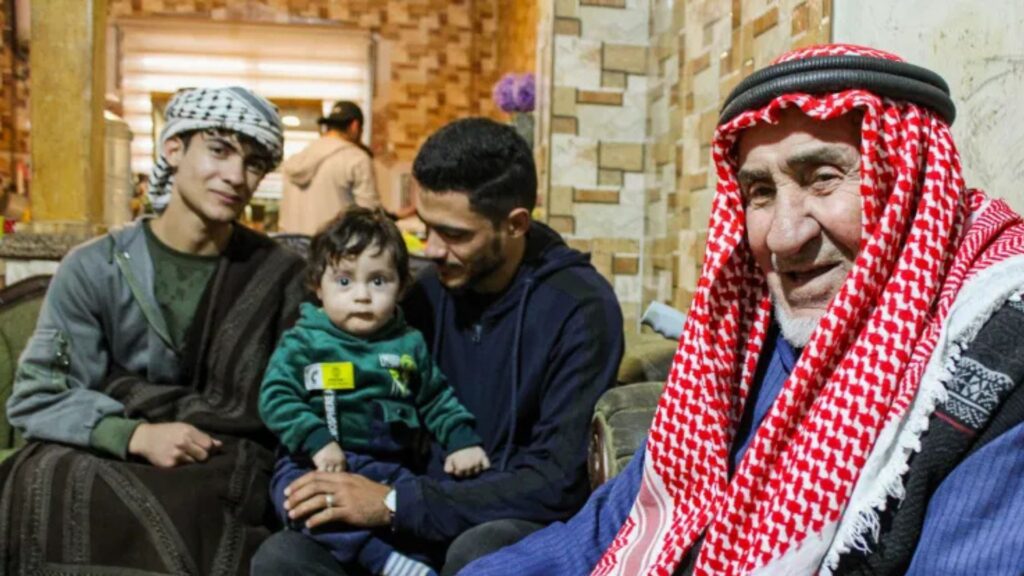
“I wish I could return,” young Mohammad, who wears a black-and-white keffiyeh around his head, says. “I want to see all of Palestine. Not just Dawaymeh, everything.”
2 December 2023
Baqaa, Jordan – Rain pours down in torrents on Jordan’s Baqa’a camp, turning the streets into rivers. The November storm’s harsh winds rattle the tin doors of thousands of homes in the largest Palestinian refugee camp in the country. But despite the heavy downpour and bone-chilling cold outside, it is warm inside the Nashwan family’s home.
Eighty-six-year-old Abdullah Nashwan beams at his great-grandson, Tayem, just one year old. His three grandchildren smile as they sift through a box of old family photos over a steaming pot of mint tea.
Abdullah’s daughter-in-law, Kausar, pulls out a photo of Abdullah and his wife Fatima, who passed away 10 years ago. “I remember her thobe [traditional Palestinian dress]. She always wore it,” Kausar’s 20-year-old son Mohammad recounts.
Kausar brings out a long velvet dress from the bedroom. It is worn, but its violet, green, pink and yellow hues are still bright, intricately stitched into a pattern of flowers. When Abdullah sees the dress, he freezes, staring deeply as if his wife had appeared from the fabric’s folds.
Like other Palestinian thobes, the embroidered pattern is unique to the woman’s village. For Abdullah’s wife, this is a town called Dawaymeh, high in the hills of al-Khalil (Hebron), in what is today the occupied West Bank.
A sharp contrast to the camp, where the thickly packed cement structures suffocate most of the plants, Dawaymeh was very green. Olive groves and expansive gardens were neatly planted on terraces etched into the mountainside, Abdullah recounts.
“My father was a farmer,” he says. “We owned a few dunums, where we planted wheat and barley. We lived off the land, and there was plenty to eat and drink. Everything was lovely,” he says.
“I wish I could return,” young Mohammad, who wears a black-and-white keffiyeh around his head, says. “I want to see all of Palestine. Not just Dawaymeh, everything.”