The war on Lebanon’s heritage
Israeli air strikes have damaged and destroyed historical sites and antiquities across the country.
23 November 2024
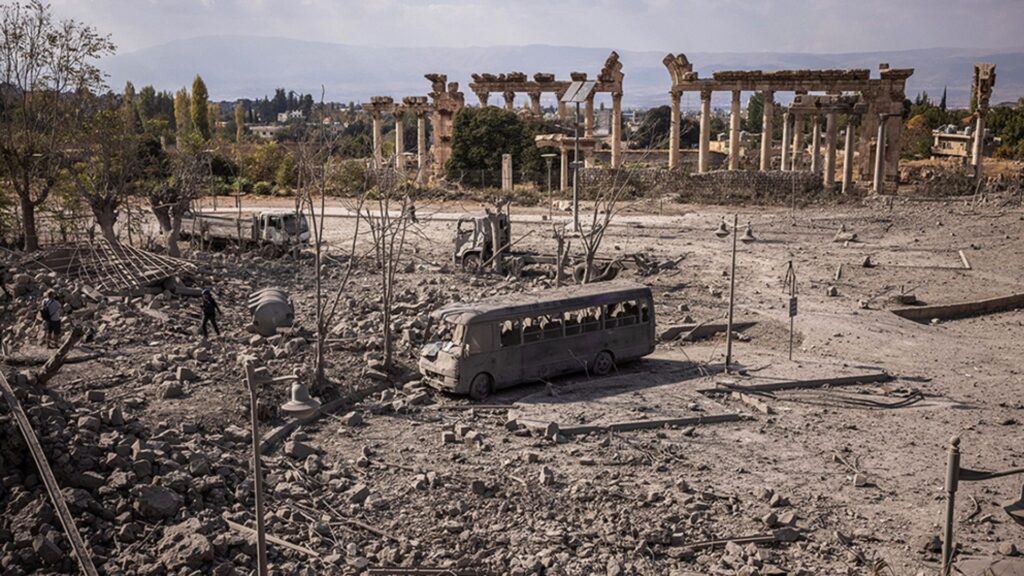
Baalbek, Lebanon – An opaque sheet of plastic covered the second-floor windows of the Palmyra Hotel, blocking the view of Baalbek’s Temple of Jupiter, one of the largest and best-preserved sanctuaries of the Roman world.
The hotel’s thick window panes had been shattered by an Israeli airstrike on November 7, which struck an Ottoman-era building across the street, reducing it to a pile of skeleton-grey rubble. After the blast, the antique wooden doors — which had opened for visitors since 1874 — were blown off their hinges, furniture overturned, and copper dinner plates scattered across the ornate tile floors.
The hotel was empty, with the normal crowds of tourists now too scared to venture into Baalbek. The Israeli army has issued multiple evacuation orders for the entire historic city and has proceeded to pound it with airstrikes. On Thursday alone in the Baalbek region Israeli strikes killed at least 47 people.
Dust from the nearby strikes still lingered on the hotel’s Victorian decor and black-and-white framed photos that still hung on the walls. A short, grey-haired man strolled down the dark hallway in solitude, periodically stopping to sweep with his feathered broom.
He told me his name was Manal Abbas, and after 56 years of working at Palmyra Hotel, it meant more to him than his own home. So, despite the surrounding danger, he would stay to care for it. “I’ve spent my life here, more than I’ve spent in my home,” 77-year-old Abbas said.
Smiling, he recounted late nights serving drinks to the many celebrities who frequented the hotel. “The stereo was always on at night. Festivals were held and ballets would come. We would stay up until morning,” Abbas said.
The renowned French poet and playwright Jean Cocteou, Jazz singers Ella Fitzegerald and Nina Simone, and Lebanese icons Fairuz and Sabah are just a few of the stars who once booked rooms. “Fairuz was a formal, who didn’t usually interact or joke with anyone, she’d go straight to her room,” Abbas remembered, “Lady Sabah used to be popular and she also loved the people, if I used to be grumpy or sad she’d do anything and tell me to smile for her.”
Over time, the hotel has become a time capsule of sorts. Artefacts collected throughout the hotel’s 150 years are on display in every corner: letters from its famed guests, fragments of Roman columns, newspapers dating 1926, and excavation surveys of Baalbek’s acropolis, which comprises several Roman temples. Albert Einstein even allegedly left his diaries during his stay.
Like many other pieces of heritage and history, these are all at risk of destruction in Israel’s war, which it says is against Hezbollah targets, in Lebanon.