In northeastern Syria, artists fight to preserve a cultural renaissance
In northeastern Syria, a growing community of artists—dancers, musicians, filmmakers—fights to preserve the region’s diverse heritage and sustain more than a decade of cultural revival.
2 December 2025
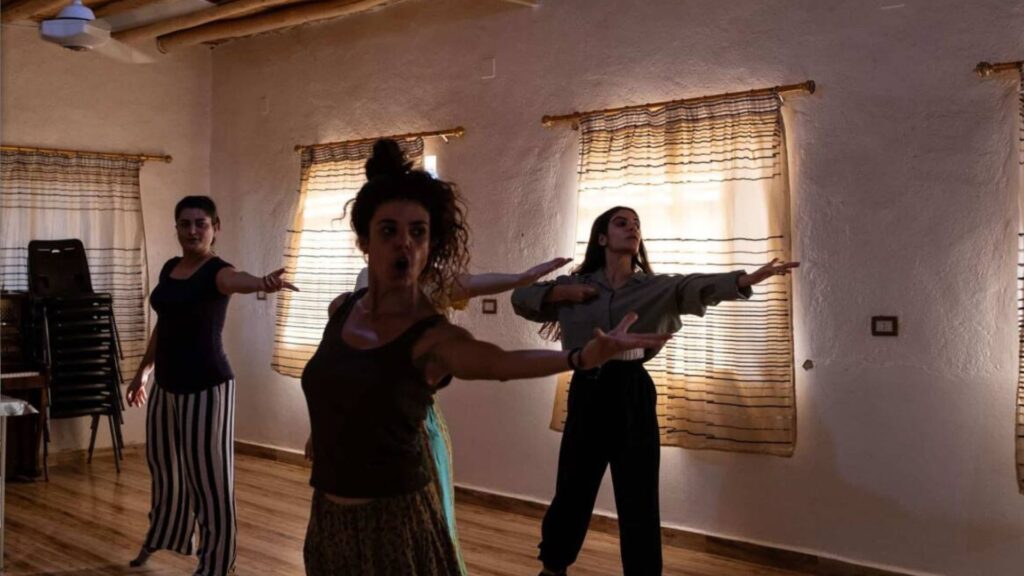
Qamishli, Syria – The dancers pound their feet to the heavy beat of drums. In unison, each raises a right arm into a fist and draws it back, poised to shoot an invisible bow. They release, and together spin toward the mud walls of Welat Art House—Hunergeha Welat in Kurdish.
Across the open-air courtyard at the art house in Syria’s northeastern Qamishli city, Yazan al-Taama, 24, strums an oud, the instrument’s melancholy hum reverberating in the small room. He plays one of his father’s favorite songs, from his hometown of Raqqa. “You have to stay connected to your heritage and bring it forward to make the world aware,” al-Taama says.
Outside, a few artists mingle and talk while others prepare tea and lunch in the kitchen. They are among the 25 musicians, dancers and filmmakers who live and work at Welat Art House—part of a growing community of artists in Syrian Kurdistan, also known as Rojava, fighting to preserve the region’s diverse heritage.
“This land is a place of mixed ethnicities, the region is diverse,” one of Welat Art House’s founders, Shêro Hindê, 45, tells Syria Direct. “We hope to see its Kurdish, Arab, Assyrian and Armenian arts all working together.”