At Poland’s borders, Ukrainians are welcomed while refugees from elsewhere face a growing crackdown
‘The army is much meaner and more focused on disturbing our work.’
26 May 2022
BIALYSTOK, Poland — More than 3.5 million of the 6.5 million people who have fled Russia’s invasion have entered the EU at the Poland-Ukraine border, mainly to open arms and a hot meal. This situation stands in stark contrast to the reception for refugees from the Middle East, Africa, and South Asia a couple of hundred kilometres to the north, in Poland’s densely forested northeast.
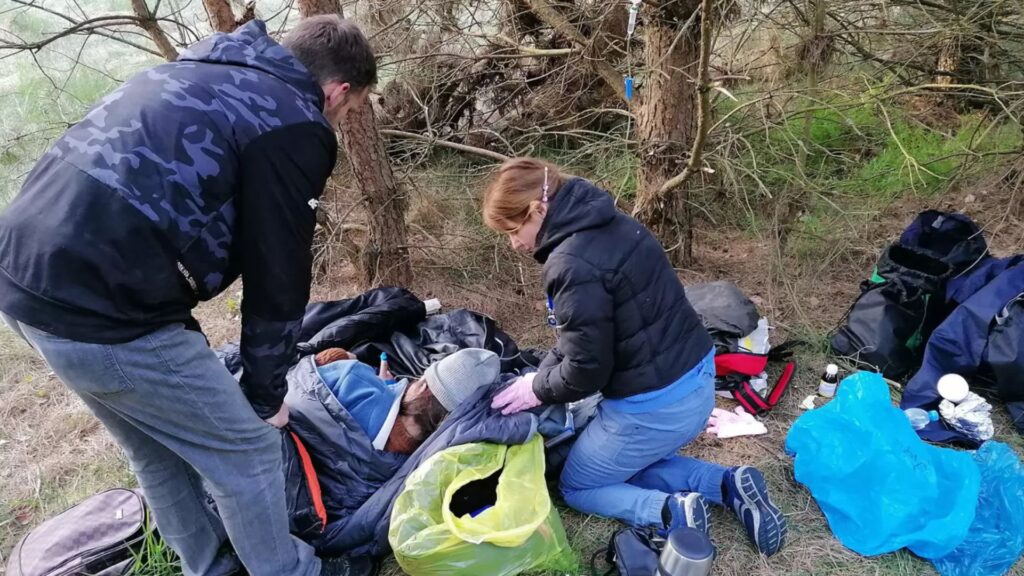
Thousands of soldiers and police continue to patrol the border with Belarus as construction on a 350-million-euro wall intended to keep out asylum seekers and migrants nears completion. Meanwhile, aid volunteers are bracing for an uptick in attempted crossings during the warm summer months while contending with increasingly hostile treatment from authorities.
“For the people who flee from Ukraine, when you go to the border and put them in your car and your home, you are a hero; when you do the same for someone who passed the Belarusian border, you are a criminal. This is something we cannot understand,” said Maria Radwańska, the 39-year-old coordinator of Warsaw’s Club of Catholic Intelligentsia (KIK), a Polish civil society organisation that operates an aid station near the Poland-Belarus border.
A geopolitical showdown last year led to a sharp increase in the number of asylum seekers and migrants attempting to enter the EU from Belarus. The situation turned into a humanitarian crisis as EU member states Lithuania, Latvia, and Poland deployed their armies and police and pushed people back from their borders, while Belarusian security forces tried to push them back into the EU. Thousands ended up stuck in the forest – facing abuse from both sides – and at least 21 died.
During the harsh winter months, the crisis largely slid from view as the number of people crossing declined and attention shifted to focus on Russia’s invasion of Ukraine, which began at the end of February.
However, volunteers The New Humanitarian spoke to during a recent visit to the Poland-Belarus border said they are seeing a fresh uptick in asylum seekers and migrants attempting to cross.
Grupa Granica, a network of Polish NGOs and activists providing humanitarian assistance to people along the border, said they received between 120 and 200 calls for help per week during March and April – a significant increase – and that the number of people attempting to enter Poland has at times surpassed what they saw last autumn.
The increase coincides with warmer temperatures as well as with Belarus expelling almost 700 people from a makeshift camp opened to house them during the winter in Bruzgi, a town near the border.
Many of those who remained in Belarus – and who are now attempting to enter Poland – are among the most vulnerable caught up in the crisis. They include people with disabilities and chronic diseases as well as families with children, even mothers with babies born in Belarus over the winter, according to Anna Alboth, from the NGO Minority Rights Group, who also volunteers with Grupa Granica.
Others attempting to cross now have recently entered Belarus from Russia – including new arrivals from countries in the Middle East, such as Iraq, Yemen, and Syria, and foreigners who had been living in Russia but are now attempting to leave due to the impact of sanctions and fears of a widening conflict.
“This route [from Belarus to Poland], it’s already open; it’s already on the map for potential migrants. This is not going to stop any time soon,” Monika Matus, a spokesperson for Grupa Granica, told The New Humanitarian.