Jordan's street art movement colours its urban landscapes
Jordan’s limestone landscapes are getting a makeover, hip-hop style. Street art across the Levant has shot up recently, none more so than in Jordan where artists are emboldened to imprint their style and identity onto their urban surroundings.
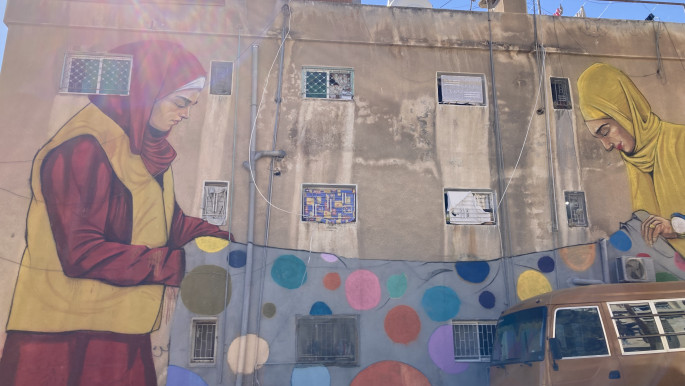
Amman/Irbid, Jordan — Jordan’s urban landscapes have become the canvas for a growing number of street artists – the cities’ sand-coloured backdrops are now speckled with colour.
To the onlooker’s gaze, the wall-high street murals beautify the streets and entertain passers-by. But when one looks deeper, nearly every mural holds another meaning; reflecting the gaps between tradition and modernity in Arab society; of femininity and gender norms; of a generation of youth challenging traditional norms embedded within a conservative society.
In the last decade, the street art scene has boomed in Jordan. The artwork now spreads out from the country’s capital Amman, decorating the Kingdom from the southernmost city, Aqaba, to Irbid in the north.
In Madaba, about 30 kilometres south of Amman, three portraits of women are painted on three abandoned shop doors. The first shed a tear, the second has been abused, and the third holds inside her tears before they pour.
“I love these three women,” said the artist, Nada al-Qarra. The 25-year-old artist is one of the dozens of street artists active in Jordan’s graffiti scene, many of whom are women, rare in the traditionally male-dominated sphere.
Nada said she was drawn to street art about seven years ago, but at the time the streets of Madaba, her hometown, were devoid of artwork.
The young artist became one of the first to paint the city, more conservative than parts of Amman. She said that in the beginning, those around her were sceptical of her artwork, mostly portraits of women that depict the female emotions “not always comfortably shared.”
But Nada continued her artwork, undeterred by the scepticism. “I like the idea of painting on the streets to force the public to get into the idea I want to share,” she stated.
North of Madaba in Irbid a nearly 20-metre-tall woman grips an orange rose, while doves encircle her shoulders. The artist, Laila Ajjawi, 32, said the woman is married, and “wants peace in the house”, the mural was done to spotlight the increase of gender-based violence during the pandemic.
Laila grew up in Irbid’s Palestinian refugee camp, one of the ten camps for Palestinian refugees in the country. “Growing up in the camp, there was graffiti all the time,” she said, her passion for street art influenced by the graffiti she was surrounded by in her childhood.
Her first street art mural was during the 2014 war in Gaza. “I felt that this wall could only reflect my anger,” she said. Since then she has used her art to raise awareness for the Palestinian cause, as well as women’s rights.
“Street art is my personal interest and my mission,” Laila said, “It has given me another dimension to express.”