'She said no, then got killed': Jordanian women protest against surge in femicides
With the growing number of cases of murder of women on account of their gender, activists call for legal reforms to protect potential victims
10 July 2022
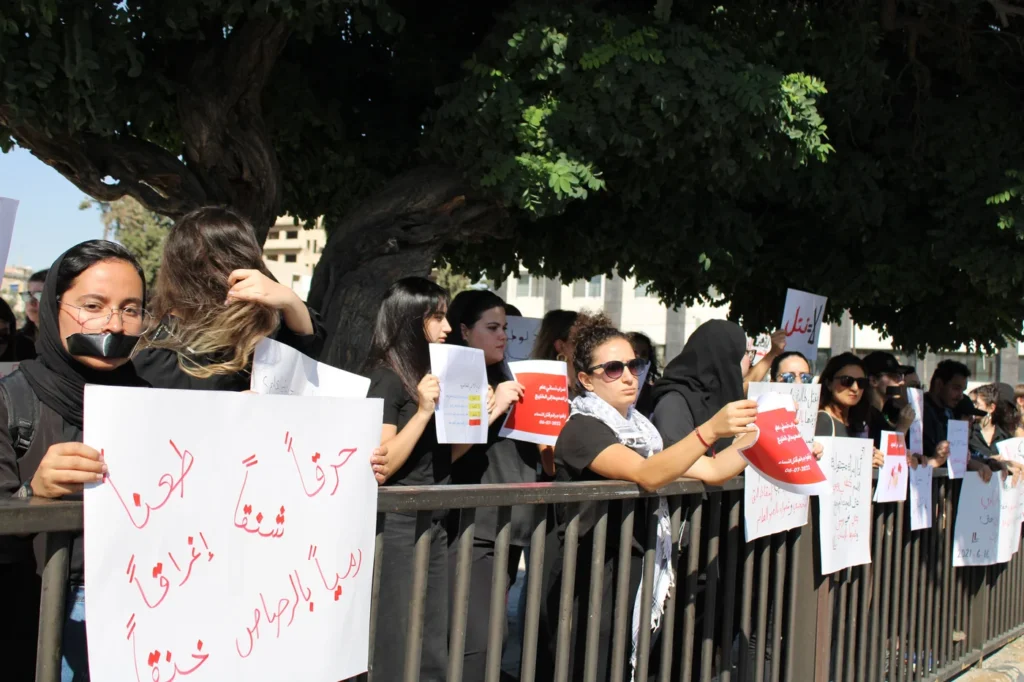
Amman, Jordan — “Words cannot describe the anger, despair, and sense of injustice that I feel and wake up with every single day since the most recent wave of femicide started,” said Diana Ishaqat, 27, who attended a silent sit-in in front of Jordan‘s parliament on Wednesday to bring attention to the recent increase in murders of women in the country and to commemorate those who have died.
The sit-in followed the stabbing of a woman by her husband outside a courthouse in Karak, south of the capital, Amman, on Monday, less than two weeks after 21-year-old Iman Rashid was fatally shot on her university campus in Amman, and a 20-year-old Jordanian woman was murdered, stabbed 15 times in a parking lot, by her husband in the UAE.
“Burned, stabbed, drowned, thrown, suffocated, dumped… ” read one protester’s sign at the sit-in, decrying the various ways women have been murdered in Jordan.
“Once upon a time, a girl said no, then she got killed,” another sign read.
The recent slew of femicides – the killing of a woman on account of her gender – has sparked conversation on social media and in the streets and provoked a state of social anxiety regarding these crimes.
“Regular conversations I have with fellow women describe nightmares, a sense of hopelessness, and the search for bag-sized self-defence tools,” Ishaqat told MEE, “It’s never just one woman, there’s always a next… “
Ghaida Saket, 24 and a member of Takatoat, an independent feminist collective based in Jordan that helped to organise the sit-in, said that they received calls from activists across the region to engage in a cross-border silent protest, triggered by recent murders, including one in Egypt.
Saket told MEE that these murders occurred in public spaces, and that the shift from the private to the public space is a “really big red flag”.
“What it says is that nobody cares whether anyone sees the crime being committed,” she said.
“There is a huge increase in anxiety and a feeling of insecurity and absence of safety among peers and those around us. Any of us could be the next victim, in the public eye, in the middle of the street, in the middle of the day.”