Syrian artists fight for a ‘free space of creation’ post-Assad
In post-Assad Syria, many artists are experiencing a freedom of expression they have never known, one they are determined to hold on to.
6 March 2025
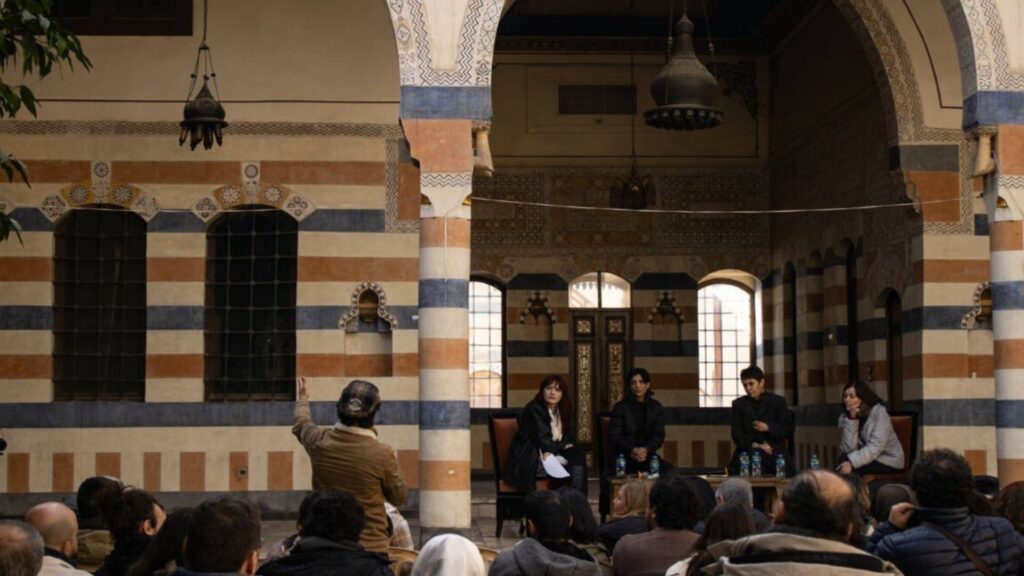
Damascus, Syria – Down a winding, stone-gray alleyway in Damascus’s ancient city center, a small door opens to a large, sunny atrium. Inside, nearly 200 Syrian artists gather: musicians, actors, dancers, singers and even a clown.
Seated under ornate archways and the enveloping branches of an orange tree, the group discusses the role of art in a newly liberated Syria. “We are trying to care for our culture,” Nora Mourad, an actress and the founder of the physical theater company Leish Troupe, tells the crowd.
“There is a lack of trust between us and the new regime,” she continues, calling it her “duty as a citizen” to promote and protect the future of Syria’s art space.
In post-Assad Syria, many artists are experiencing a kind of artistic freedom they have never known. New galleries are opening, with artists displaying works banned or restricted under the former regime for the first time.
For decades, the Assad regime tightly controlled Damascus’s vibrant cultural hub, particularly concerned with art deemed even remotely political. Cultural events required complicated permissions and bypassing these procedures was dangerous.
The artists’ gathering, held on February 6, was organised by Ettijahat, a Syrian cultural organization founded in exile. It was the first in-person event Ettijahat was able to organize in the Syrian capital in 13 years, Ettijahat’s director, Abdullah al-Kafri, told Syria Direct. “Today, merely a few months after the fall of the regime in Syria, the need for cultural and artistic entities is more crucial than ever,” he says.
Following a nearly two-hour discussion and a musical performance in the Damascus courtyard, the assembled artists mingled. Some had traveled from abroad, and others from distant parts of Syria. Many shook each others’ hands for the first time.
Mourad, with a smile stretched across her face, embraced her friends and peers. She nodded, listening to their ideas for Syria’s art community. “I’m a Syrian citizen, I’m living a historical moment of change that I never dreamed of,” she told Syria Direct between conversations.
“I feel a huge responsibility, as someone who chose to stay here [in Syria] and work all these years,” she said. “My duty was to stay with the younger generation, to show them that art, during the war, could be a safe place to express, to heal, to dream. Today, the duty is much bigger and much more difficult, because when you deal with uncertainty, it’s scary.”