The Devastation of Lebanon’s Southern Border Towns
Months after Israel’s withdrawal from most of the country, the frontier zone remains an impossible place to live
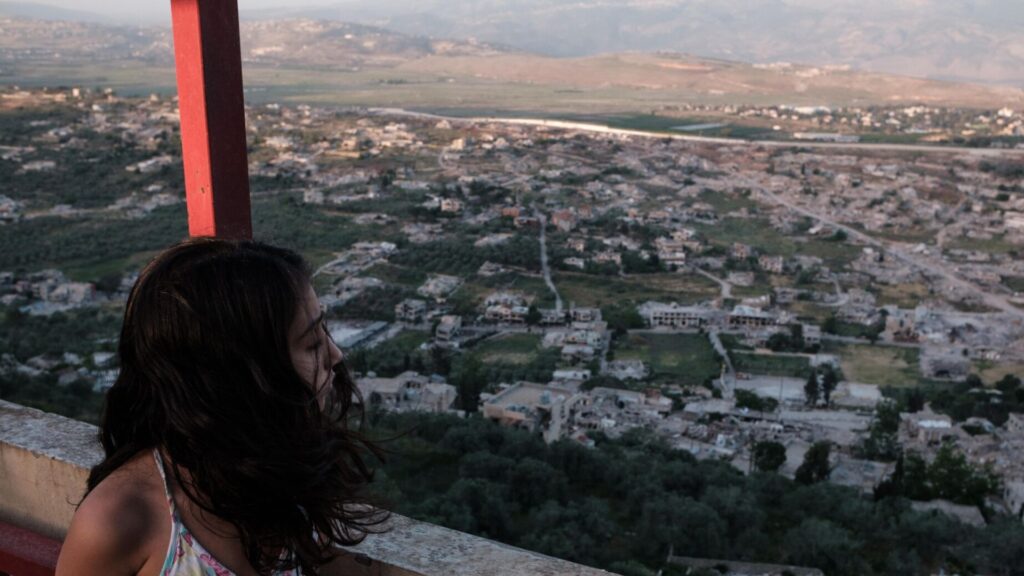
23 May 2025
Kfar Kila, Lebanon –
Some residents trickle in and out, gathering their belongings or attempting to repair their homes. Months after Israel’s withdrawal from most of Lebanon following a ceasefire agreement in November 2024, the vast majority of people displaced from Lebanon’s southern frontier zone are still unable to move back in. The immense destruction and continuing Israeli strikes render their villages unlivable.
At the entrance to Kfar Kila, a village on Lebanon’s southeastern border with Israel, a few men were gathered outside an old gas station. “There’s no electricity, no water, nothing, most people can’t return,” 45-year-old Mounif Hammoud told me, sitting beside an idle pump.
Hammoud, like the other men at the station, comes to Kfar Kila during the day, then leaves at nightfall. His home was destroyed, and he said that he has neither the cash nor the assurance to rebuild. “Every time we build something new, they bomb it.”
Israeli troops withdrew from Kfar Kila on Feb. 18, but only about 30 of the village’s 5,500 residents have returned so far, the village’s mayor, Hassan Chit, told me somberly over the phone. He said that 90% of homes were completely destroyed, along with the village’s electricity and water infrastructure, farmland and nearly 3,000 olive trees.
The scene in Kfar Kila was replicated in the majority of the eight villages we stopped in along the border. All were situated within roughly 2 miles of the Blue Line, the boundary between Lebanon and Israel as demarcated by the United Nations. In most places, the majority of the destruction occurred after the ostensible ceasefire was signed on Nov. 27, rather than during the more than 13 months of fighting prior to that.
“The border villages continue to lack the basic necessities that allow people to come back,” said Ramzi Kaiss, a Lebanon researcher at Human Rights Watch. “The majority remain, unfortunately, uninhabitable. The controlled demolition of hundreds of homes and razing of critical key infrastructure,” he added, made it “impossible for people to return.”
Hammoud guided us through Kfar Kila in his dusty white Honda flatbed truck. A lone white horse crossed the street in front of us, galloping out from the rows of devastated buildings.
We pulled over at what was once a bakery, the sign’s bright yellow and red paint still shining. Hammoud said it opened on March 14, as villagers attempted to return. For two days they had enjoyed fresh flatbread, until an Israeli strike on March 16 set the bakery on fire. All that remained of it was a single door frame and plastic cutlery poking out from the charred debris.
A few minutes’ drive from the bakery was an unfinished cinderblock house, just a stone’s throw from a wall erected along the Israeli border. In the backyard, a grove of dozens of olive trees had been uprooted, their roots left bare.
The home belongs to Ali Hammoud Chit, a local farmer, who was rebuilding it for his wife and three young children. He was hoping to return to his land, where he had been harvesting his father’s olives and farming tomatoes, he told me by phone.
One morning in mid-April, however, he returned to the village to find signs plastered on his unfinished walls. “Never allow Hezbollah members to return, at all, to your house or the general area, to avoid being exposed to danger. Don’t make your family, relatives and neighbors pay a heavy price. He who warns is excused,” the signs read in Arabic. The message was addressed to a man named Abbas Ali Saleh, whom Chit said he did not know.
Since Chit found the signs, he has nearly ceased the construction of his home. The hour-long trip from where he now resides, near the coastal city of Sidon, no longer seems worth it, he said.