25
Lebanese find bones and memories of Israeli abuse in Khiam's ruins
Rescue workers begin missions to retrieve bodies in the border town, many of which are now just skeletons
Khiam, Lebanon — Mountains of rubble and debris line the roads in Khiam, on Lebanon’s eastern border with Israel. Months of heavy fighting between Hezbollah and Israel have left most of the town unrecognisable.
The buildings still standing are ridden with bullet holes. Some walls and doors have been entirely blasted off, revealing overturned furniture inside. Others bore traces of the presence of Israeli soldiers, who had occupied the area for around six weeks before withdrawing on 12 December.
Trash left by Israeli forces is littered throughout homes, and walls have been vandalised with provocative graffiti.
In one three-storey house, past the military schedules scrawled into the stairwell, Israeli soldiers had scattered their faeces in bags around the rooftop.
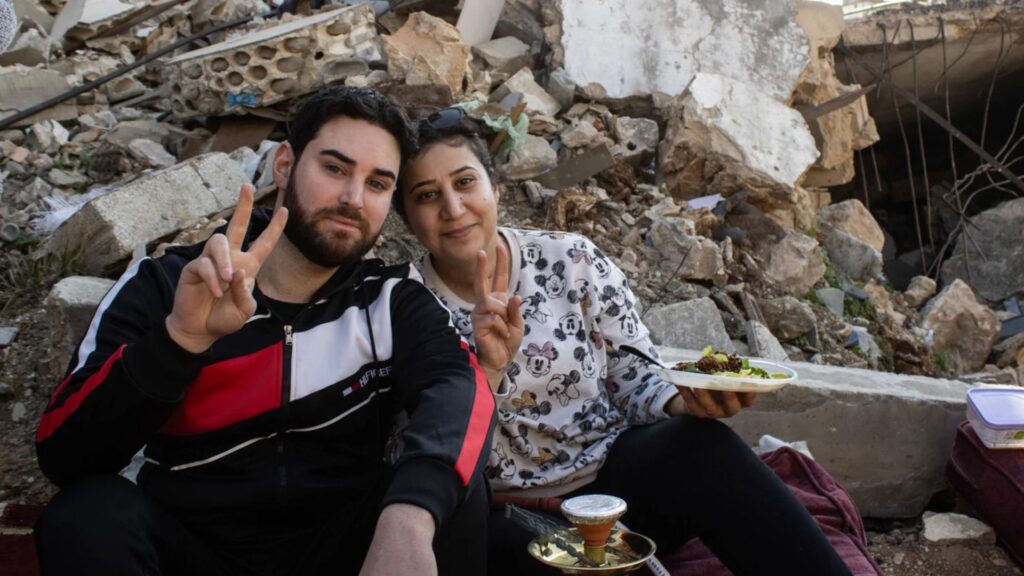
Despite the destruction, Khiam’s residents are still returning. Down one dusty lane, a group of neighbours were picnicking atop the rubble of their homes.
They laughed as they passed plates of mujadara hamra, a traditional lentil dish from south Lebanon, sipped on hot coffee, and smoked from shisha pipes.
“One’s soul has returned,” said 28-year-old Ali Awad, sitting next to his neighbour, Zainab Aqil. “This is my home and this is her home,” he told Middle East Eye, pointing to the pile of shattered cinder blocks behind him.
“This is our village, we are rebuilding it, and we are bringing it back to life,” he said.
Awad and his neighbours have been staying in Nabatieh, about 24 kilometres west of Khiam, but have returned to their town every day since 26 January, the date originally set by the November ceasefire agreement for Israel and Hezbollah to withdraw from south Lebanon.
However, Israel has accused Lebanon of not fully enforcing the agreement’s terms and it was extended until 18 February.