Despite Assad’s Downfall, Less Than 10% of Syrian Refugees Have Returned
28 July 2025
More than six months after Assad’s fall, only a fraction of Syrian refugees have returned home. Most remain abroad, deterred by the continued lack of housing, basic services, security, and economic opportunities.
The war displaced more than half of the country’s prewar population of 22 million. By the end of 2024, an estimated 7.4 million Syrians were internally displaced, and around 6.1 million had taken refuge in more than 130 countries.
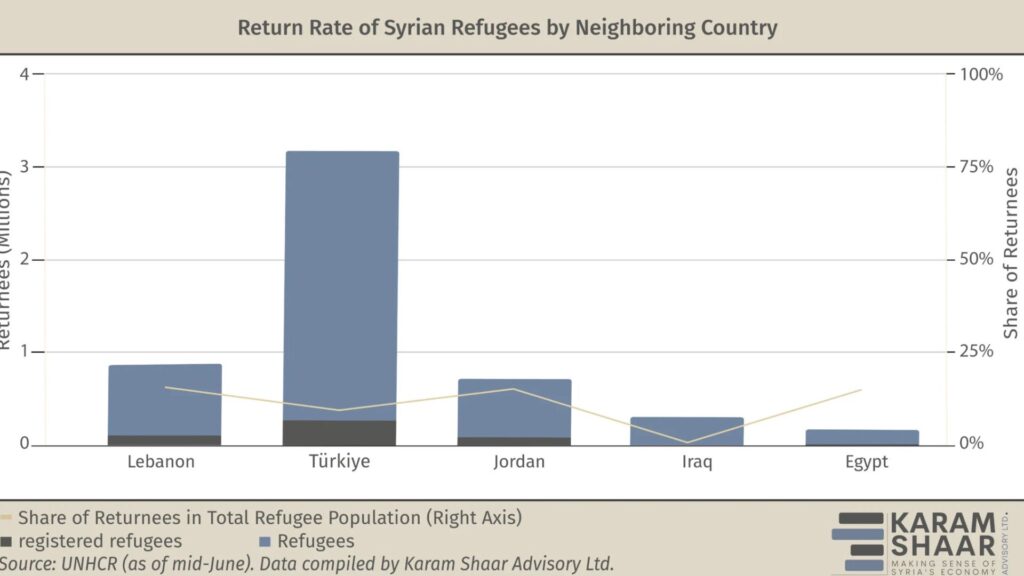
The UN Agency for Refugees (UNHCR) estimated in mid-June 2025 that approximately 577,266 Syrians living abroad had returned since December. This represents less than 10% of the refugee population abroad. Similarly, only about 17% of those displaced inside the country—roughly 1.2 million people—have returned as of May 2025.
According to UNHCR data from September–November 2024, most refugees initially fled to neighboring countries: Türkiye (2.9 million registered refugees prior to the fall of the regime), Lebanon (0.8 million), Jordan (0.6 million), Iraq (0.3 million), and Egypt (0.1 million). An estimated one million unregistered refugees also reside in Türkiye. In Lebanon, the government estimates the total number of refugees in the country at around 1.5 million.
The definition of “permanent return” varies slightly by host country, and many Syrians now re-enter the country temporarily. As a result, tracking and comparing return patterns is difficult. In Lebanon, UNHCR tracks returns through de-registration figures. Since December, nearly 120,000 have been deregistered. Many others have crossed the border temporarily to check on homes or visit family; these movements are not counted as returns in UNHCR statistics.
UNHCR Egypt noted in mid-June that over 22,200 refugees had requested closure of their case files since December 2024, signaling intent to return. The agency also reported that 16,400 refugees had “spontaneously departed,” though it is unclear whether they left permanently or temporarily.
In Jordan, returns are measured via crossings at the Jaber–Nassib border, UNHCR spokesperson Yousef Taha told Karam Shaar Advisory Ltd. The UN agency estimates 94,000 registered refugees have returned since December.
In Iraq, refugees must formally deregister with UNHCR before returning permanently. Just 2,160 individuals had done so between December and June—fewer than 1% of the total refugee population as of November 2024, according to the UNHCR spokesperson in Iraq, Lilly Carlisle.
In Türkiye, Syrians under temporary protection must apply for return; once approved, their Temporary Protection Identity Document is canceled. Turkish authorities report over 273,000 voluntary returns since December, according to UNHCR spokesperson Selin Unal, interviewed for this publication.