Dreams of Tremseh come alive as thousands return to Syrian village
In Tremseh, an idyllic village in northern Hama with a bloody past, thousands of displaced residents have found their way home. Reunited with old friends, they are working to rebuild a community and heal old scars.
5 August 2025
Tremseh, Syria – Driving east of Hama city, toward Syria’s coastal mountains, the dry desert dust gradually gives way to green. A ways farther down the winding road, a village comes into view, perched atop a hill in the distance.
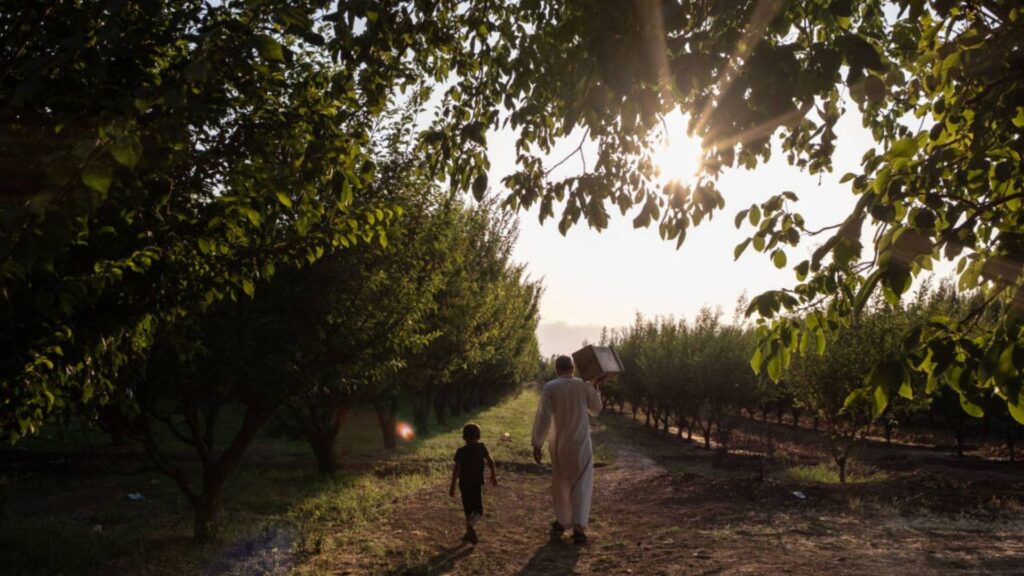
Those entering the village are greeted by clear springs, spurting buckets of drinkable water. A canopy of peach, plum and pomegranate trees stretches out as far as the eye can see. Fish jump in a stocked pond, and songbirds fly overhead on a clear summer day.
This is Tremseh, a home lost and now regained by thousands of residents newly returned after years of displacement in crowded camps. Together again, they are attempting to rebuild their community and heal the scars of a bloody past.
Inside one home, Bassam al-Jassem, 40, cools off from the afternoon heat with his two close friends. Propped up on pillows and stretching out on the tile floor, they sip coffee and puff on cigarettes, laughing at jokes and sharing their stories of the past—and the future they hope for.
The majority of the Tremseh’s 14,000 residents fled following a massacre on July 12, 2012, dispersed in all directions. Protests against the regime of Bashar al-Assad had swelled in the village, where the opposition Free Syrian Army (FSA) had a presence at the time.
That day, “before the sun rose, we were suddenly surrounded from all sides with tanks and many soldiers,” Jassem remembers. For four hours, Assad’s helicopter gunships and tanks bombarded the village. Then ground forces and pro-regime shabiha militiamen stormed in, carrying out execution-style killings.
Early reports of the death toll varied, from 300 to around 100. The Syrian Network for Human Rights (SNHR) has documented the killing of 67 civilians in Tremseh that day, including six children and a woman. Al-Jassem and his friends maintain that more than 300 were killed.
At first, al-Jassem remained in Tremseh, the village now firmly under regime control. The following year, like so many of his neighbors, he could no longer stay. He fled to Atma, a town in Idlib province close to the Turkish border, where a cluster of displacement camps were emerging. He would be there for the next 12 years.
He married there in 2015, and became a father to three children whose bedtime stories were tales of Tremseh, with its clear springs and green canopies heavy with fruit.
“It was a dream to return,” al-Jassem says. “We kept our memories [of Tremseh] alive, where we were children, remembering its streets with the hope of returning, the hope of victory.”