Terror in Nabatieh: On the front line of Israel’s war on Lebanon
First responders make daily sacrifices to save people, while victims of Israeli strikes speak of immense pain and trauma
Nabatieh, Lebanon – On a hilltop in Lebanon’s southern city of Nabatieh, rescue workers stood on standby, ready to respond to the near-constant Israeli air strikes below.
The destruction sprawled out in front of their eyes: homes, workplaces and the city’s near thousand-year-old market reduced to piles of charred rubble.
They had just spent the previous night and day rushing to extinguish fires following over 10 Israeli strikes on the small southern city in less than 24 hours.
Ambulances, fire trucks, and other rescue vehicles were parked nearby. Some of the vehicles had been damaged in Israeli air strikes. Their windshields were cracked, doors dented, windows sometimes replaced by sheets of loose plastic.
Many of the rescue vehicles were damaged on 16 October, when Israel pounded the centre of Nabatieh, the main city in the Jabal Amel area, with consecutive air raids, the head of Nabatieh’s civil defence force, Hussein Fakih, told Middle East Eye.
The strikes targeted the city’s municipal building, killing its mayor and at least 15 others, with 52 people wounded.
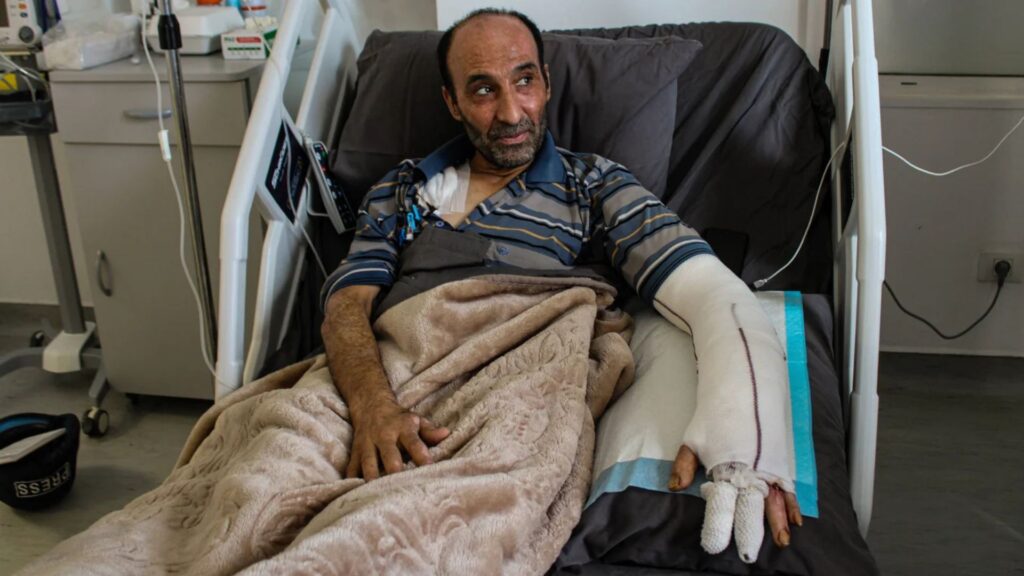
That day, Fakih and his team rushed to help the victims, but while they were clearing bodies from the rubble, an Israeli air strike hit an adjacent building, wounding him and six of his colleagues.
Fakih, 52, spent 18 days in hospital – including seven under intensive care – for severe wounds to the head and lungs.
Just days after being discharged, he was already back on the job.
“We have to continue our work, although what is happening is unacceptable,” he said. “There is no respect for the protection of rescue workers or medical staff.”
As of 25 October, Israeli attacks have killed at least 163 health and rescue workers across Lebanon and damaged 158 ambulances and 55 hospitals, according to Lebanon’s health ministry.
Another Israeli attack on 16 October hit just 40 metres from a civil defence centre in Nabatieh, wounding three more rescue workers and killing one, 30-year-old Naji Fahes.
“He had two children,” Fakih said quietly, remembering his friend and colleague.
“We are experiencing a great loss,” he said, “because these men are heroes, in every way.” Choking up, Fakih turned around to catch his breath before he could continue the interview.
After a few minutes, he turned back around and said: “Despite the strikes, the obstacles that are happening, and all the suffering, the civil defence workers remain present… Citizens depend on us to save them.”